
Burren National Park: access starts with Corofin
Burren National Park protects state-owned land within the larger Burren landscape. Entry is free and the park is open throughout the year. That access does not extend to every field or limestone pavement in the surrounding region: the Burren is also a working landscape with private land. Keep the park boundary, the named trail and your intended access point clear when planning a walk.
NPWS recommends starting in Corofin. The information point is at the Clare Heritage Centre on Church Street, with toilets there. There are no visitor facilities at the Kenny’s Cross and Gortlecka trailhead, and no designated roadside parking. Use the arrival guide to plan the journey instead of treating a narrow roadside space as a trail car park. Corofin parking is free.
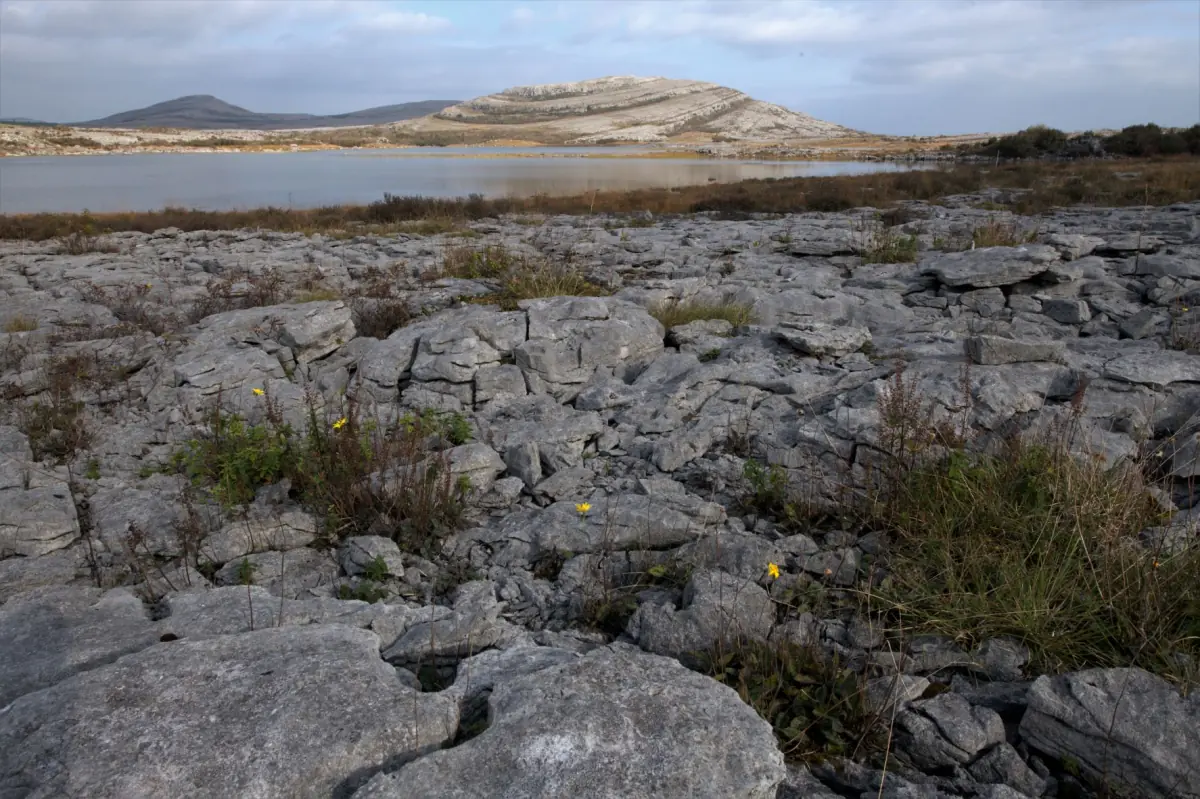
Mullaghmore and the shorter marked trails
The orange Knockaunroe route is 1.3 km and the white Nature Trail is 1.5 km. These shorter distances offer alternatives to a Mullaghmore route, but the wider warning about rough limestone still matters. Wear sturdy footwear and choose the route for the terrain and conditions as well as its length. Short distance alone does not describe the underfoot difficulty.
The blue Mullaghmore Loop is 7.5 km, the green return route 6.5 km and the red traverse 6 km. NPWS grades the Mullaghmore variants very difficult. They should not be presented as easy family walks. Pick a route that everyone can complete, leave time for the return and turn back when weather or footing makes continuing unsuitable.
Walking in the Burren with a guide
NPWS guided walks are free, with booking required because places are limited. Their subjects include habitats, plants, animals and geology. Arranged group walks are available for groups of at least four people. This is an opportunity to make the details of the landscape the focus of the visit, rather than simply aiming for a distant viewpoint.
Non-NPWS guides need ranger permission to lead walks in the national park. This is a requirement for those guides, not an individual hiking permit for every visitor. A vehicle excursion through the wider Burren is a different experience from a guided walk on national park land. For vehicle-based options elsewhere in the region, see the separate Burren tours page.
Flora and flowering seasons
Arctic-alpine and Mediterranean plants grow alongside each other in the Burren. Mountain avens and bloody cranesbill are examples of the plant communities described by NPWS. The limestone landscape is also shaped by winter grazing, which helps keep vegetation short into spring and supports varied flowering. The open appearance is therefore part of a relationship between nature and land management.
Spring gentian flowers within an April to June window, while mountain avens has a May to July window. May and June overlap, but a flowering period is not a promise that a particular plant will be in bloom beside your trail. Look carefully without picking plants or stepping off the marked route for a photograph. For the seasonal context, read when to visit the Burren.
Limestone, fossils and care on the trail
The limestone formed from deposits in a tropical sea during the Carboniferous. Glaciers exposed rock surfaces, while rainwater dissolves limestone and widens its joints. Looking at those surfaces is part of understanding the park, but stones and fossils must stay where they are. Photograph a find instead of collecting it, and avoid publishing precise fossil locations.
Use marked routes and existing stiles, close gates and keep off stone walls. Do not disturb livestock or wildlife. Dogs are allowed in the national park only on a lead. That rule must not be carried over to the Burren Way, where dogs are not allowed, including leashed dogs on farmland. The history of farming and settlement gives more context for the land you are crossing.
The Burren Way outside the national park
The Burren Way is a separate linear route from Lahinch to Corofin, using roads, old cattle tracks, paths and forest roads. Yellow arrows on black identify it. Sections include traffic, so it should not be described as a continuous off-road nature trail. Plan a particular legal section and its return transport rather than assuming that the entire itinerary is currently open.
The Cliffs coastal-walk status dated 1 August 2026 closes the southern section from Liscannor and Hag’s Head to the Experience, with no through route from Doolin to the visitor centre. North of Doolin, the permitted section to Surfers Path requires returning the same way. The road there is not a safe bypass. Keep these coastal restrictions separate from access to the national park and the open designated Cliffs visitor areas.
Questions about your visit
Do I need a park entry ticket?
National park entry is free and the park is open year-round. Booking is required for the free NPWS guided walks.
Is Mullaghmore an easy family route?
NPWS grades its Mullaghmore variants very difficult. Select a trail for everyone’s ability and for the rough, uneven limestone terrain.
Can I bring my dog?
Dogs must be on a lead in the national park. The Burren Way has a separate no-dogs rule, including on farmland.